Updated: Loading...
Why the $1.2 Trillion Dropshipping Boom Is Leaving “Traditionalists” Behind: 7 Strategic Takeaways for 2026
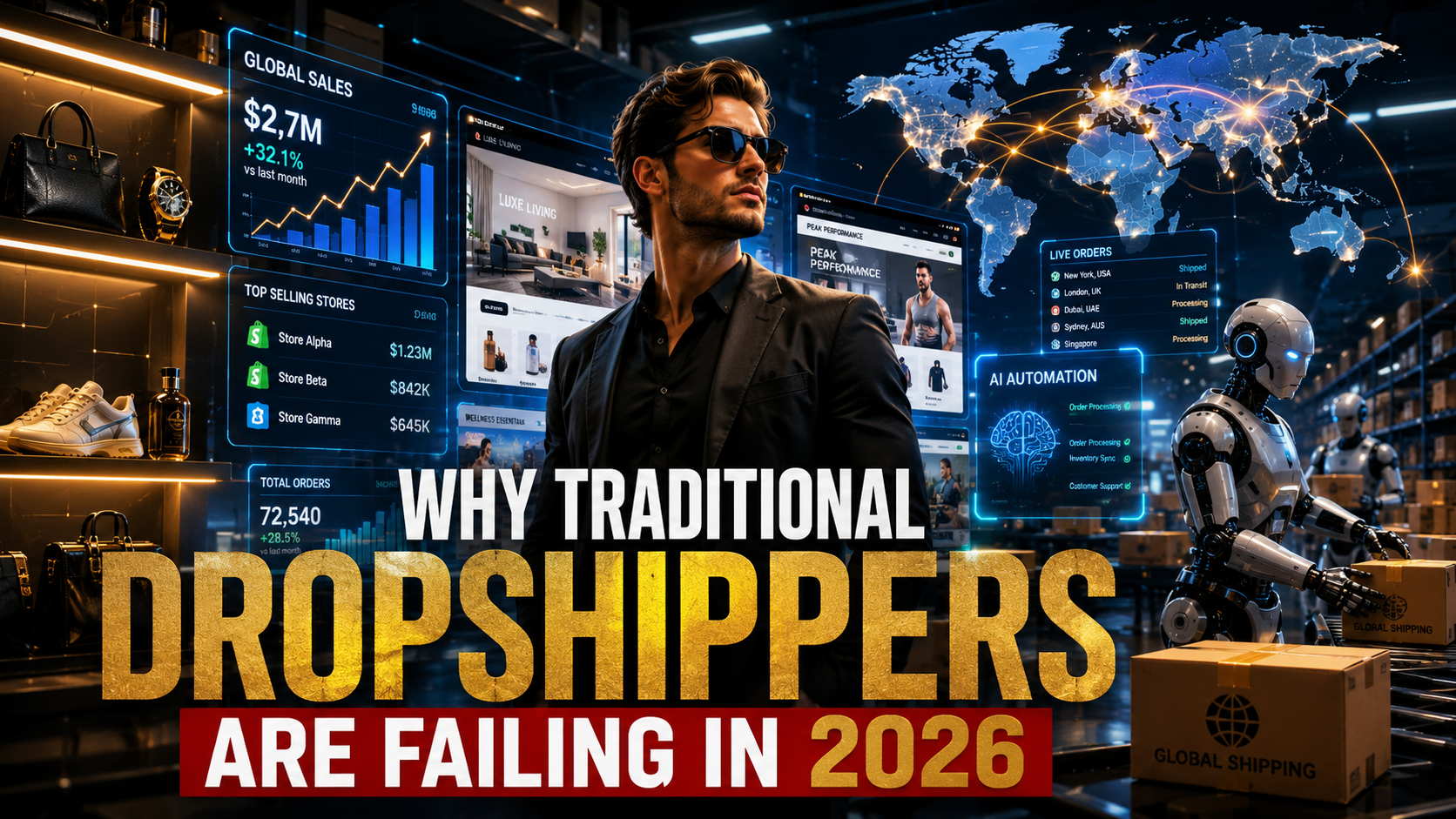
The global dropshipping market is no longer a sandbox for hobbyists; it is a high-velocity economic engine. Valued at $365.7 billion in 2024, the sector is on an aggressive trajectory to exceed $1.2 trillion by 2030. Yet, as we navigate the complexities of 2026, a brutal chasm has formed. While elite operators are achieving $40 million annual run rates, the “traditionalist” beginners are bleeding capital and failing within their first ninety days.The differentiator is not luck—it is a transition from the amateurish “picking cool products” to a rigorous, data-centric strategy. Success in this era requires understanding why the barrier to entry has vanished, and why branding is the only remaining defensive moat.
1. The Brand or Bust Rule: Escaping the Equilibrium Trap
The traditional model—listing generic items from a factory floor and hoping for a margin—is functionally extinct. Davie Fogarty, a strategist who has generated over $800 million in sales , identifies this model as “inherently flawed.” Platforms and payment processors now actively penalize low-quality, generic advertising.Operators must avoid the Equilibrium Trap . Because generic stores are effortless to launch, supply and demand reach an equilibrium almost instantly. This commoditization drives prices down to zero-margin levels, ensuring that any early success is short-lived. To achieve what Fogarty calls the “Millionaire Outcome,” you must build a brand: a cohesive set of values and a superior customer experience that prevents your product from being price-shopped into oblivion.
2. The $200 Threshold: The Strategic Case for High-Ticket Dominance
While beginners fight for crumbs in the $20 phone case market, high-level strategists have pivoted to high-ticket items priced at $200 and above. The operational burden of supporting a $20 customer is nearly identical to that of a $1,000 customer, but the unit economics favor the latter.Strategic Advantages of High-Ticket Models:
- Reduced Research Fatigue: High-ticket operators spend significantly less time chasing weekly “trends.” They focus on dominating a specific, high-value niche rather than rotating inventory every month.
- Low Price Elasticity: Luxury or specialized buyers are less sensitive to price fluctuations than budget shoppers, allowing for more stable revenue.
- Absolute Margin Buffer: A 20% margin on a $1,000 generator provides a $200 profit—enough to absorb significant customer acquisition costs—whereas a 50% margin on a $10 item leaves no room for error.The Reality Check: This requires capital. Payment processors often hold funds for up to three weeks, meaning you must have the liquidity to fulfill orders immediately to maintain shipping speeds.
3. The 60% Gross Margin Mandate
In the 2026 auction-based ad environment (TikTok, Facebook, Google), the “math of the auction” is a relentless filter. If your store does not meet the 60% Gross Margin Mandate , you are mathematically precluded from scaling.The unit economic floor for a sustainable enterprise looks like this:
- Retail Sale: $100
- Gross Margin (60%): $60
- Customer Acquisition Cost (CAC): $40
- Net Profit: $20Attempting to scale with a 30% or 40% margin is a fool’s errand; rising ad costs will cannibalize your profit before you can even cover your Shopify subscription or shipping fees.
4. Solving “Burning Desires” and the “Pattern Interruption” Variable
Successful product selection has evolved into a study of human psychology. You are no longer selling “gadgets”; you are selling relief. High-growth brands target “Big Problems”—back pain, foot health, or ADHD management—rather than “Minor Inconveniences” like motorized coolers.Strategic positioning relies on the Visual Element . In a world of infinite scrolling, “pattern interruption” is the only way to stop the thumb. This is why a pink cleaning scrub or boardshorts that change color when splashed with water go viral; the visual shock to the brain triggers an impulse action that generic products cannot replicate.
5. Case Study: The Hike Footwear Blueprint
Hike Footwear represents the gold standard of 2026 branding. They didn’t just sell shoes; they tackled the systemic issue of foot health by offering wide toe boxes and zero-drop heels. But their “Millionaire Outcome” was secured by their Mission-Driven Branding . By planting a tree for every four pairs sold, they built a defensive moat of brand loyalty. This positioning moved them beyond being a “shoe store” to being a “wellness movement,” allowing them to generate 1.6 million monthly visitors and over $2.7 million in monthly revenue.
6. The AI Divide: Technical Stack Commoditization
The technical barrier to entry has officially vanished. Tools like the Atlas AI Store Builder —which has already empowered users to generate over $45 million in sales —have reduced the store-building process from weeks to 20 minutes.By simply pasting an AliExpress link, AI now generates “handcrafted” descriptions and professional-grade product imagery. In 2026, the 20-minute store is the baseline. If you are still manually building pages, you are effectively fighting a tank with a sword. The battlefield has shifted exclusively to creative positioning and branding depth; the technical execution is now a commodity.
7. The Byzantine Maze of Nexus and the “Cookie Trap”
The modern retailer must navigate a tax landscape of 11,000 U.S. jurisdictions. We have reached the death of the “nexus-free” loophole . In 2026, even the use of “cookies” on a browser (as seen in Massachusetts) can constitute a physical presence, creating an immediate tax obligation.Furthermore, if your drop shipper has a warehouse in a state where you do not, many jurisdictions now view them as an extension of your business. This operational hurdle is compounded by international friction: 42% of consumers will permanently abandon a brand if they encounter unexpected customs duties. Tax compliance and shipping accuracy are no longer “back-office” concerns—they are deal-breakers for customer retention.
Systems Over Luck
In conclusion, dropshipping in 2026 is a game of high-level systems. The infrastructure of this $1.2 trillion era—built on CJdropshipping, Dropified, and AI-driven automation—is accessible to everyone. Therefore, the tools are no longer the advantage.The winners are those who treat their store as a brand-building exercise, prioritizing margin discipline and solving real human pain. Luck has been replaced by unit economics. Strategy has replaced guesswork.
Bonus
The final litmus test for your business: If your product disappeared tomorrow, would your customers miss your brand, or would they just find another seller for the item?